
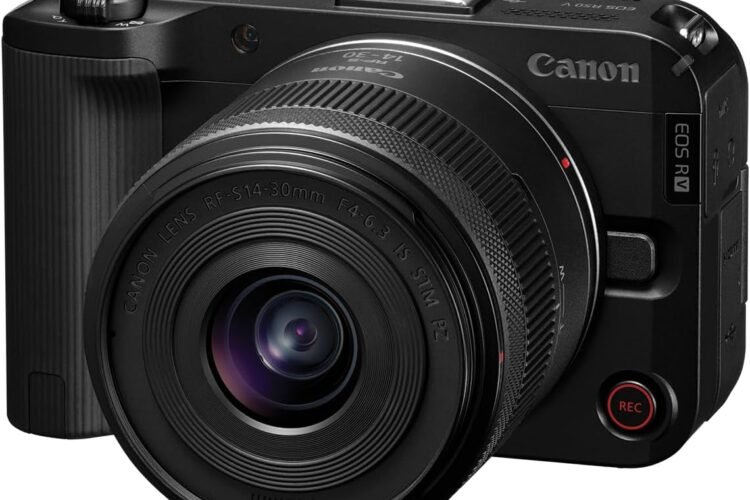
If you’re shooting with an APS‑C mirrorless camera from Canon’s EOS R line and you want a versatile zoom lens that’s ultra‐wide, compact, and content‑creation friendly, the Canon RF‑S 14‑30 mm f/4‑6.3 IS STM PZ is a smart buy. With its 14‑30 mm zoom range (22.4‑48 mm equivalent on APS‑C) it covers everything from wide landscapes to everyday framing; its built‑in power zoom, internal image stabilisation and quiet STM autofocus make it particularly appealing for creators, vloggers, livestreamers and anyone who wants versatility without heavy gear. Canon Europe+3The-Digital-Picture.com+3asia.canon+3
Key Features That Make It Special
- Ultra‑wide to standard zoom: 14‑30 mm gives you a wide field of view and flexibility for landscapes, interiors, selfies, livestreams and standard everyday shots. Canon Europe+1
- Built‑in Power Zoom: The “PZ” version includes internal zoom motor with smooth zoom transitions – ideal for video work or livestream where zooming smoothly matters. asia.canon+1
- Optical Image Stabilisation: Helps reduce shake when handheld, especially useful when zoomed in or shooting handheld video. bhphotovideo.com
- Lightweight and compact: At just around 181 g and a non‑extending zoom design it remains portable and stable on gimbals or tripods. asia.canon+1
- Quiet STM autofocus: Suited for both stills and video — minimal noise in focusing so your audio is less affected. The-Digital-Picture.com+1
Technical Specifications Overview
- Focal Length: 14‑30 mm (22.4‑48 mm equivalent on APS‑C) The-Digital-Picture.com+1
- Maximum Aperture: f/4‑6.3 (variable across zoom range) The-Digital-Picture.com
- Minimum Focus Distance: approx 0.15 m / 15 cm (giving good close‑up capability) Canon Europe+1
- Magnification: up to around 0.38× at 30mm The-Digital-Picture.com
- Filter Thread: 58 mm bhphotovideo.com
- Weight: ~181 g / 6.4 oz bhphotovideo.com+1
- Format Coverage: APS‑C sensors (RF‑S mount) The-Digital-Picture.com+1
Who Should Consider This Lens?
- Content creators and vloggers: The ultra‑wide 14mm is perfect for handheld travel videos, self‑recording, livestreams, while 30mm gives more standard framing. Smooth power zoom makes footage look more polished.
- Travel and hobby photographers: Light gear is key on the move. This lens gives you flexibility in one compact package.
- APS‑C mirrorless users growing their kit: If you’re in the Canon RF ecosystem and want a good all‑rounder lens, this covers a lot of ground without breaking the bank.
- Hybrid shooters (photo + video): Quiet focus, stabilisation and power zoom give video benefits, while still offering decent still image quality for photos.
Pros & Considerations
Pros:
- Very wide zoom range for an APS‑C zoom – gives flexibility across many scenes.
- Excellent portability thanks to compact size and light weight.
- Power zoom and stabilisation make it video‑friendly.
- Good close‑focus capability for detailed shots or product/creative work.
- Strong value compared to many premium zooms.
Considerations:
- Maximum aperture is variable and relatively modest (f/4‑6.3) — in low‑light you might need to raise ISO or use faster primes for better shallow depth of field.
- Because it’s designed for APS‑C, if you upgrade to a full‑frame RF body this lens will either not be appropriate or auto‑crop; keep your system context in mind.
- Some distortion at the ultra‑wide end and corner softness has been noted in reviews (e.g., 14mm) — this is typical at this price/size class. The-Digital-Picture.com
- For serious portraits with strong bokeh or extreme telephoto needs this is not the lens — it’s aimed at versatility over specialist performance.
Setup & Usage Tips
- Use the 14mm end for scenery, wide interiors, travel, self‑recording. Zoom toward 30mm when you want tighter framing or subject emphasis.
- For video, experiment with the power zoom ring — set slow zoom speeds for smooth transitions, especially when zooming while recording.
- Enable image stabilisation and set your body to IBIS + lens IS if your camera has it — you’ll benefit most from handheld work.
- Since max aperture is modest, in low light consider using a tripod or raising ISO thoughtfully to maintain image quality.
- Because it’s so compact, it’s a great lens to pair with smaller camera bodies and gimbals — travel kit friendly.
- Use the 58 mm filter thread to attach ND filters if you’re doing video outdoors and want to control shutter speeds.
- Always shoot RAW (if you’re doing stills) to give yourself more flexibility in editing, especially if corner softness/aberrations are present in the wide‑end.
- Update firmware on both camera body and lens (if applicable) to ensure best autofocus performance and stabilisation compatibility.
Final Thoughts & Recommendation
If you’re in the Canon RF APS‑C system and looking for a lightweight, versatile zoom lens that serves both stills and video—especially travel, vlogging, or general everyday shooting—the Canon RF‑S 14‑30mm f/4‑6.3 IS STM PZ is an excellent option. It may not match large aperture primes or ultra‑telephoto zooms in specialist use, but it covers a lot of ground and gives you a very workable tool for many scenarios.
Whether you’re doing travel, content creation, family photography or hybrid video + photo work, this lens makes a lot of sense.